On 11 August 2026, Anthropic announced that its Claude models watermark the text they produce. The capability has been riding in models released since 2 August 2026, the day Article 50 of the EU AI Act began to apply. A voluntary code of practice on transparency of AI-generated content, published on 10 June 2026, supports those duties; the binding dates come from the regulation itself. The mark is invisible, sits in the text itself rather than in metadata, and travels when the text is copied and pasted. It is one of the first large-scale implementations of its kind for plain text; the underlying scheme builds on Google DeepMind's SynthID-Text, which Google already runs in Gemini.
And because most professional text now passes through an AI tool at some point, the interesting question is not what this means for Anthropic. It is what it means for you.
What did Anthropic actually ship?
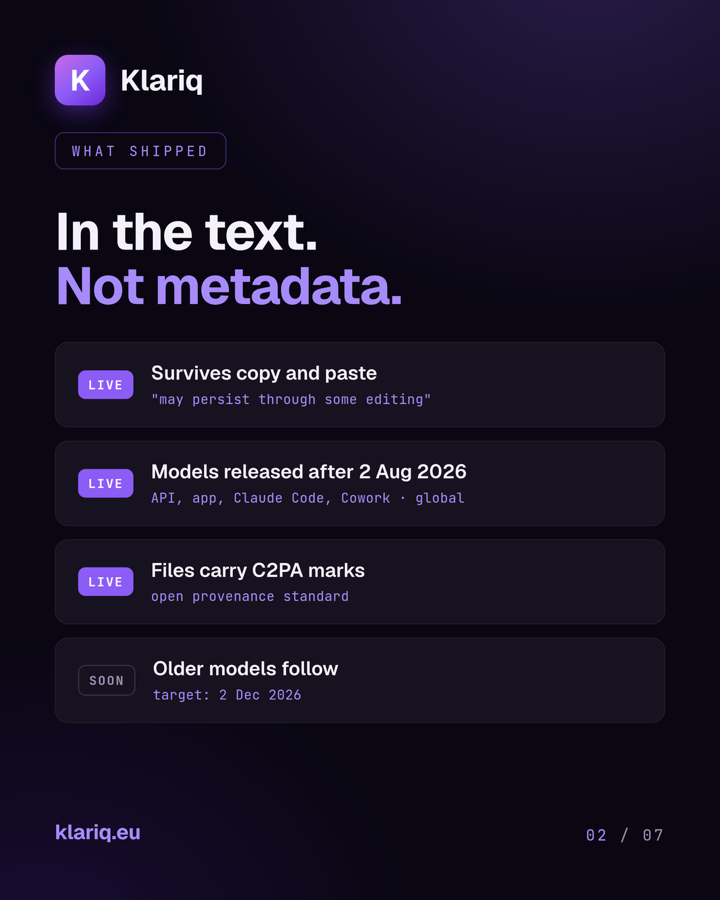
A statistical watermark embedded at the moment of generation. Not a label, not metadata: the pattern is part of the words themselves, so it survives copy-paste and, in Anthropic's words, "may persist through some editing." Files additionally carry provenance marks via the open C2PA standard, signed so later alterations can be detected.
It applies to models released from 2 August 2026 onward, across the Claude products (API, app, Claude Code and others), worldwide rather than EU-only. Older models are targeted for retroactive support by 2 December 2026. Anthropic says it will release verification tools so users and third parties can check the marks; no timeline yet. No opt-out has been announced.
Why those dates are not a coincidence
Article 50 of the EU AI Act has applied since 2 August 2026. It makes machine-readable marking of AI-generated content a duty for providers of generative systems. Systems already on the market before that date have a grace period for the marking, to 2 December 2026.
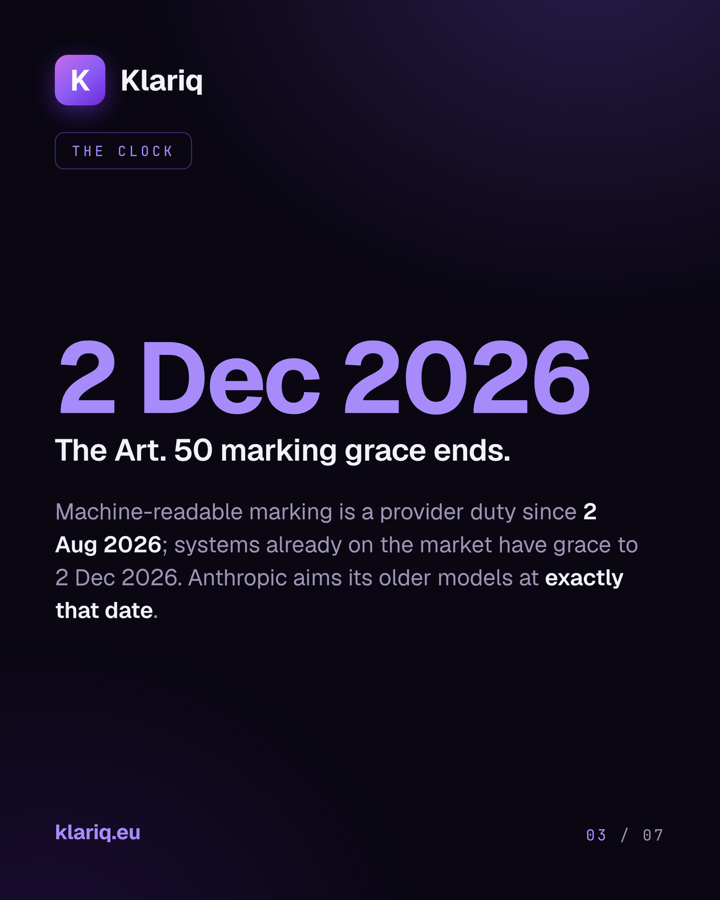
Read Anthropic's calendar against the law's: new models marked from the day the duty applies, older models by the day the grace period ends. The ecosystem is synchronizing on the regulation's dates. Several other large providers signed the same transparency code of practice. One careful note: signing a code of practice is a public commitment and a way to demonstrate effort. It is not a legal shield, and it closes nobody else's duties.
Does this make my company compliant?
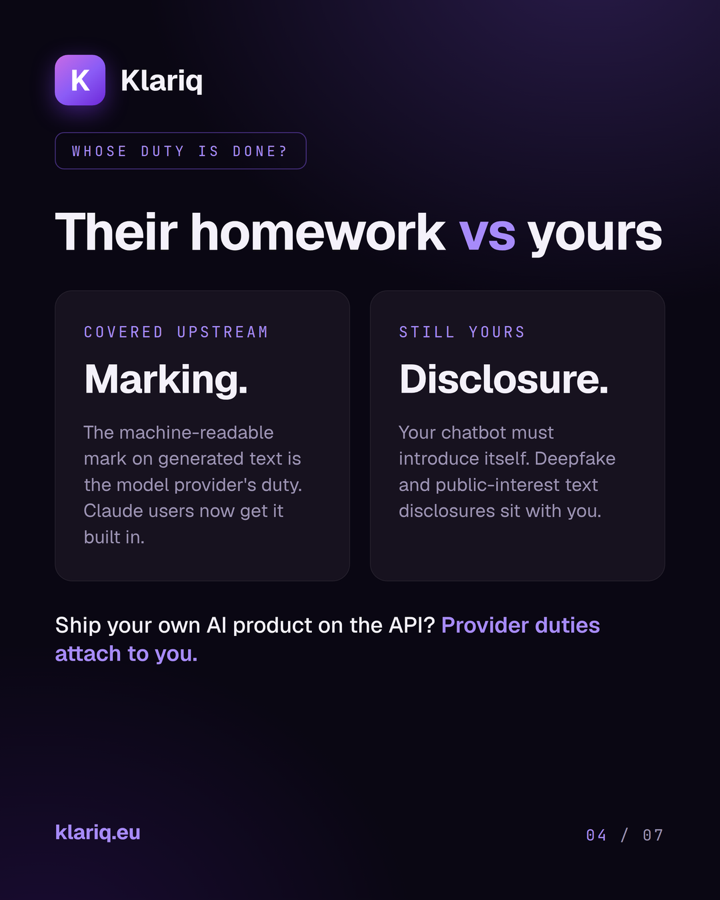
No, and this is worth being precise about. The duty the watermark addresses belongs, under Article 50(2), to the provider of the AI system that generates the content. If your company uses Claude, that box is now ticked upstream. Your own duties are untouched:
- Your customer-facing chatbot must still make clear it is an AI. Article 50(1) places that design duty on the chatbot's provider, and a bot built or branded as yours usually makes that you. It has no grace period and has applied since 2 August 2026.
- If you publish deepfakes, or AI-generated text meant to inform the public on matters of public interest, the disclosure duty sits with you as the deployer.
- If you ship your own AI product built on the Claude API under your own name, provider-style duties attach to your system.
One vendor closed one duty. The rest of the file is still yours.
You write with Claude. Should you worry?
Short answer: no, provided your story and your process agree. Here is the longer answer, in three parts.
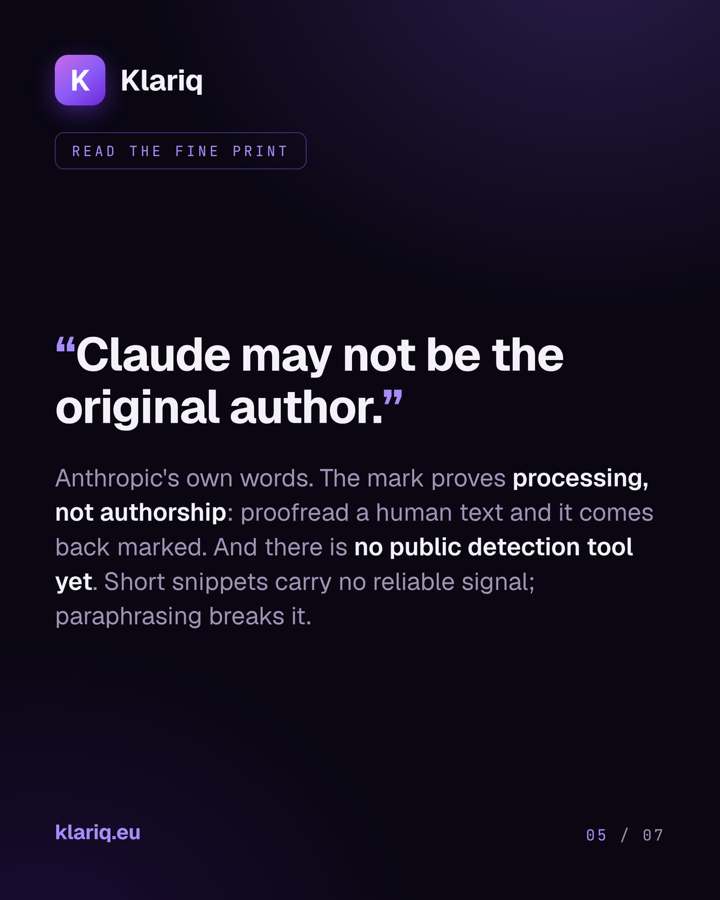
First, understand what the mark proves. Anthropic states it plainly: "Claude may not be the original author." The watermark marks what Claude processed, not what Claude wrote. Ask Claude to proofread your human-written press release, and the text comes back marked. Detection is also one-directional: a positive result means a Claude model touched the text at some point. A negative result means nothing at all; the text may predate the watermark, may have been edited or translated past recognition, or may simply be too short to carry a reliable signal. In The Decoder's summary of Anthropic's own caveats: the absence of a watermark proves nothing. A mark this humble cannot carry the accusations people will want to load onto it.
Second, the law does not mind you writing with AI. There is no duty in the AI Act to disclose AI assistance in ordinary business writing. The narrow deployer duty for text covers content published to inform the public on matters of public interest, and even there the Act carves out content that "has undergone a process of human review or editorial control" where a person "holds editorial responsibility" for it. Read that twice, because it is the most reassuring sentence in the whole regulation for anyone who writes with a machine: the law itself blesses the workflow most professionals already use. Draft with the model, review as a human, put your name on it.
Third, the only real exposure is a claim you cannot support. "Written without AI" used to be unfalsifiable. It is now a claim that a verification tool may someday test, and if a text passed through an AI tool once, for a grammar pass or a translation, the mark may say so. So retire purity claims you cannot evidence, decide deliberately which document types run through AI tools, and write that decision down. Then the watermark stops being a threat and becomes a description of your process.
What does the future look like?
An outlook, clearly labelled as one. Verification tools will ship, and the first wave of users will over-read them: expect stories of texts "caught" being AI-written that turn out to be human work with an AI grammar pass. The processing-versus-authorship distinction will be learned in public, at someone else's expense. Procurement questionnaires, HR policies and editorial guidelines will start asking about provenance, and companies with a one-page AI-use register will answer in one line while everyone else drafts nervous emails.
Then the signal inverts. As the other code-of-practice signatories ship their marking and C2PA spreads through files, marked text stops being informative, the way "this email passed through a server" is not informative. Within a few years, an AI mark on professional text will read like spellcheck: evidence of tooling, not of authorship. The window that matters is between now and roughly 2028, while marks exist but understanding lags. That window rewards exactly one thing: knowing your own process well enough to describe it.
This article passed through Claude
We drafted it with Claude, checked every claim against fetched sources and our own fact register, and a human read it, changed it, and signed it before it went out. If a verification tool ever finds a mark in this text, it will be reporting the truth: a machine processed these words. The judgment, and the responsibility for every claim above, stayed human. That is exactly the line the law draws, and it is a comfortable line to stand on.
The four checks to run this week
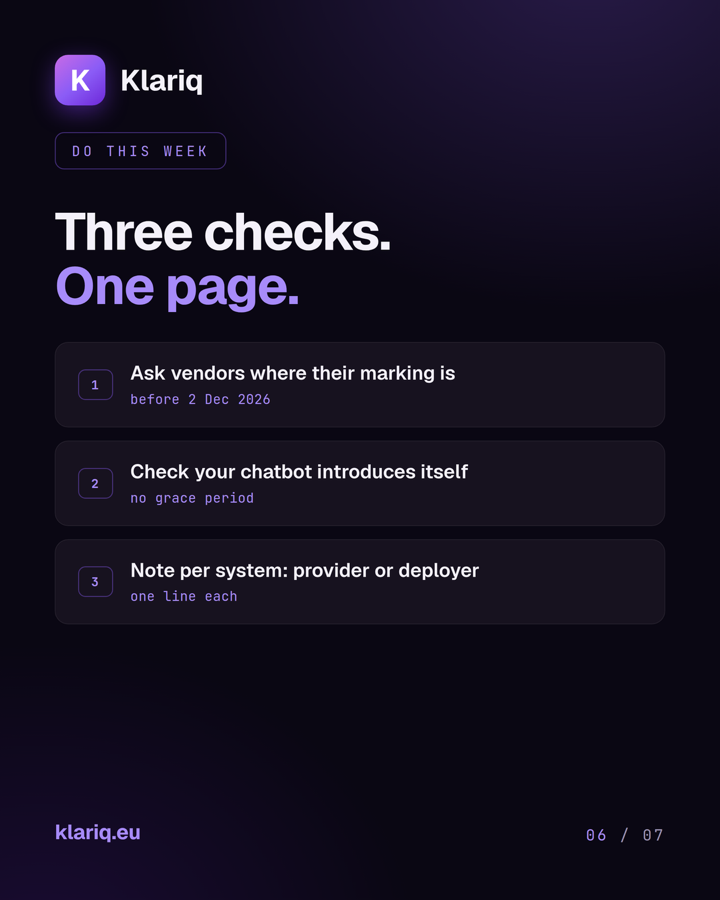
- Ask your AI vendors where their machine-readable marking is, and whether it lands before 2 December 2026.
- Open your own chatbot as a first-time visitor. If it does not introduce itself as an AI, that is your gap, and it has no grace period.
- Write the one-page register: per AI system, are you the provider or the deployer?
- Retire any "no AI involved" claim you cannot evidence, and note which document types run through AI tools.
Four yes answers and you are ahead of most. Anything else: klariq.eu runs a free five-question risk check, and the 249 EUR pack turns the answers into the six documents you want on file.
Definitions
- Provider: develops an AI system, or has it developed, and places it on the market under its own name.
- Deployer: uses an AI system under its own authority in a professional context.
- Machine-readable marking: a mark software can detect, embedded in AI-generated content; under Art. 50 a provider duty.
| Situation | Duty | Who | Applies since |
|---|---|---|---|
| Chatbot interacts with people | Inform users they are dealing with AI | Provider | 2 Aug 2026 |
| System generates synthetic content | Machine-readable marking of outputs | Provider | 2 Aug 2026, marking grace to 2 Dec 2026 for systems on market before 2 Aug 2026 |
| Deepfake | Disclose artificial generation or manipulation | Deployer | 2 Aug 2026 |
| AI text published on matters of public interest | Disclose artificial generation or manipulation (waived after human review or editorial control with a person holding editorial responsibility) | Deployer | 2 Aug 2026 |
This guide describes the rules as they stand; it is not legal advice for your specific case.
Reporting: TechCrunch, The Decoder, Tech Times, Euronews, 10.-11.8.2026. Law: Regulation (EU) 2024/1689, Art. 50, via the AI Act Explorer (artificialintelligenceact.eu).